
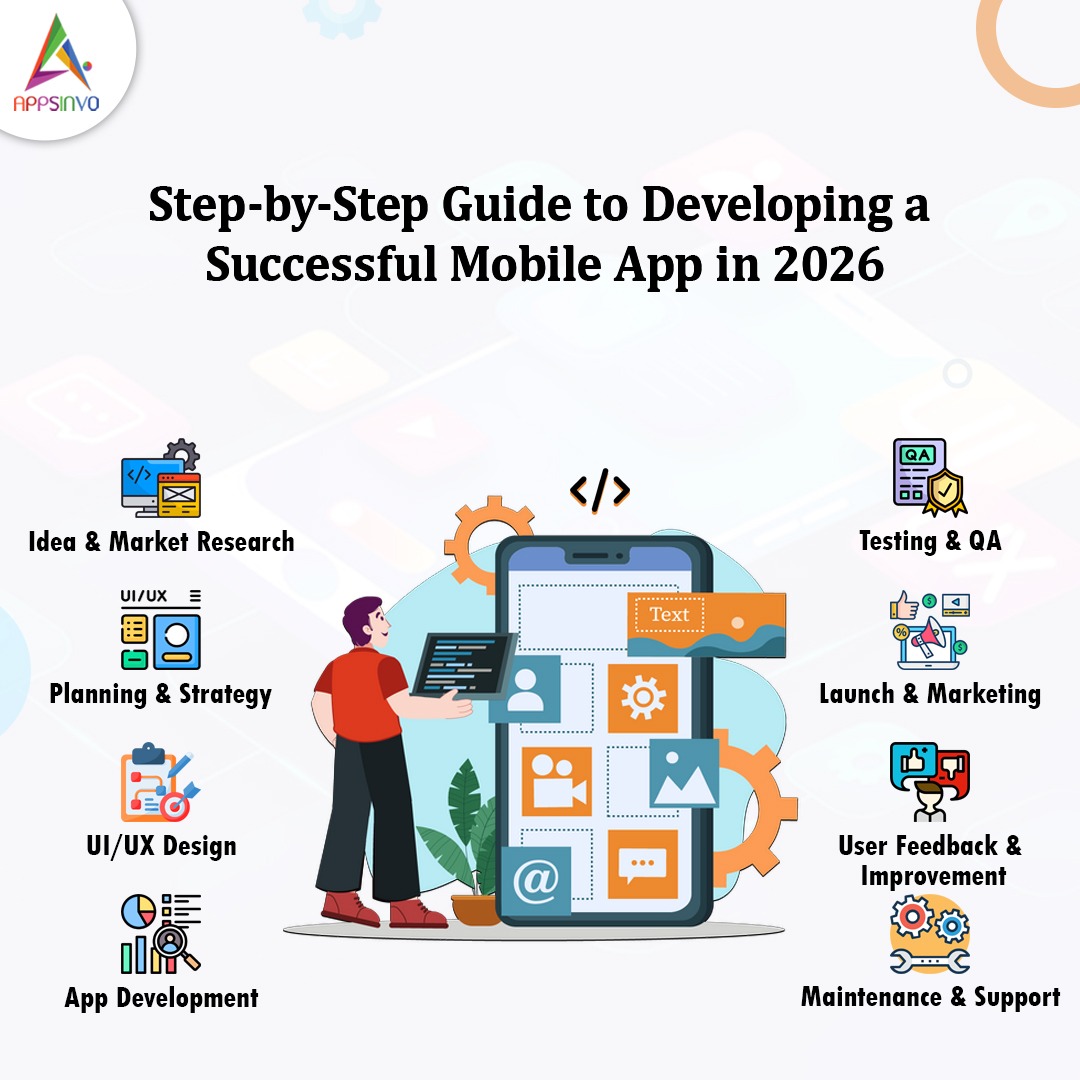
The mobile application market is projected to increase rapidly by 2026, creating a competitive climate in which startups, entrepreneurs, and businesses must be smart in designing their apps. The addition of cutting-edge technology such as AI, blockchain, and IoT has made app development both more challenging and rewarding.
Before you begin development, you must first create a plan that aligns with your business goals. In this article, we will go over a step-by-step approach for building a successful mobile application, explaining why working with an experienced team of developers like Appsinvo can help your project succeed.
- Identify the target audience
Understanding who your app is for is the first step in developing your app concept. Determine your target audience based on their demographics, tastes, and behaviours.
- Define the problem-solving approach
Once you’ve identified your target audience, explain how your software can help them solve problems or improve their daily lives. The more specific, the better.
- Market Research Importance
Carry out extensive market research to uncover trends, gaps, and opportunities. Evaluating existing solutions can help you develop your app’s unique features.
Step 2: Conduct Competitive and Market Analysis.
- Analyse competitors.
Assess your competitors’ strengths and weaknesses. Use tools like SWOT analysis to figure out how to differentiate your app.
- Identify monetisation models
Investigate other monetisation methods, such as in-app purchases, subscriptions, or advertising. Select a model that is consistent with your audience’s buying habits.
- Validate the idea using the MVP approach
Design a Minimum Viable Product (MVP) that focuses on fundamental features. This technique enables you to test the market before investing heavily in development.
Step 3: Select the appropriate technology stack.
- Native, hybrid, or cross-platform
Choose a development strategy: native for maximum performance, hybrid for a faster launch, or cross-platform for more reach. Each has merits and cons.
- AI-Powered Applications
AI can improve the user experience by providing personalised content, predictive analytics, and chatbots.
- Cloud Infrastructure
Using cloud services increases scalability and flexibility. Consider cloud-native architectures, which allow for simple updates and maintenance.
- Cybersecurity Best Practices.
Prioritise security by using encryption, data protection, and compliance measures to protect user information.
- User-centric Design
User interface (UI) and user experience (UX) design are critical components of user retention. Create designs that reflect your target audience’s tastes.
- Wireframing and prototyping
Before beginning development, generate wireframes and prototypes to visualise the app’s design and user flow. This aids in collecting early input.
- Smooth Navigation and Accessibility
Ensure simple navigation and accessibility features. A good UX can have a major impact on user pleasure and engagement.
Step 5 – Agile Development Process
- Sprint Planning
Implement Agile methodologies in an iterative development process. Plan sprints to divide the project into digestible chunks.
- Backend and Frontend Development
Concentrate on both backend server-side operations and frontend interfaces. Collaboration among teams ensures a coherent app.
- API integrations
Include third-party APIs that provide additional functionality, such as payment gateways or social media integrations. This improves the user experience.
- Functional Testing
Perform functional testing to ensure that all features work as planned. This phase aids in detecting issues early in the process.
- Security Testing
Conduct thorough security testing to identify weaknesses. Protecting user data is critical to sustaining confidence.
- Performance Testing
Test the app’s performance under various scenarios to confirm that it works properly on all devices and platforms.
Step 7: App Launch and Deployment
- Google Play and App Store Guidelines
Familiarise yourself with app store guidelines to avoid delays in your app’s launch. Following these rules can make the approval process go more smoothly.
- ASO (App Store Optimisation)
Optimise your app’s store listing with relevant keywords, interesting descriptions, and eye-catching graphics. This improves exposure and downloads.
- Marketing Strategy
Develop a marketing strategy in advance. Use social media, email campaigns, and influencer collaborations to generate excitement for your app’s debut.
- Performance Monitoring
Use analytics tools to track user behaviour and performance. This data can be used to make necessary modifications and enhancements.
- Regular updates
Consistently update the app in response to customer input and technical improvements. This keeps the app current and exciting.
- Feature enhancements
Plan for new features after the launch. Continuous improvement can increase user satisfaction and retention.
- Experienced developers:
Appsinvo has a talented development our employees that is up to date on the latest technologies.
- Cutting-edge technologies:
We use cutting-edge technologies such as artificial intelligence, blockchain, and cloud infrastructure.
- End-to-end development services
From concept to post-launch support, we provide a comprehensive service package.
- Proven Client Success:
Our track record speaks volumes. We’ve helped a variety of businesses reach their app development goals.
Conclusion
In conclusion, developing a successful mobile app in 2026 involves careful preparation and execution. Follow the step-by-step guide above to overcome the difficulties of app development. Investing in a mobile app can help you raise your business and satisfy expanding customer demands. Don’t hesitate to contact Appsinvo for a free consultation in 2026 to secure the success of your app journey.
FAQ
- How much will it cost to produce a mobile app in 2026?
The cost varies greatly based on the features, complexity, and technology. Developing a simple app typically costs between $10,000 to $50,000, whereas more complex applications might cost more than $80,000.
2. How long does mobile app development take?
Development timelines vary depending on the app’s complexity. A basic app may take 3-6 months, whereas a feature-rich app may take 6-12 months or longer.
3. Should I do native or cross-platform development?
It depends on your app’s target audience and requirements. Native apps provide superior performance and user experience, but cross-platform development saves time and money.
4. What technologies are popular in mobile app development in 2026?
AI integration, cloud-native designs, blockchain security, and the advent of super applications with numerous functionalities are among the most important trends.
5. Why is post-launch maintenance necessary?
Post-launch maintenance is critical for correcting problems, improving performance, and adding new features to keep the app relevant and user-friendly.
6. How can Appsinvo help you build a successful app?
Appsinvo offers expert consultancy, end-to-end development, and continuous support services, employing cutting-edge technology to ensure your app meets market demands.
Follow and Connect with us on
Facebook | Instagram | Linkedin | Twitter | Tumblr | Pinterest