
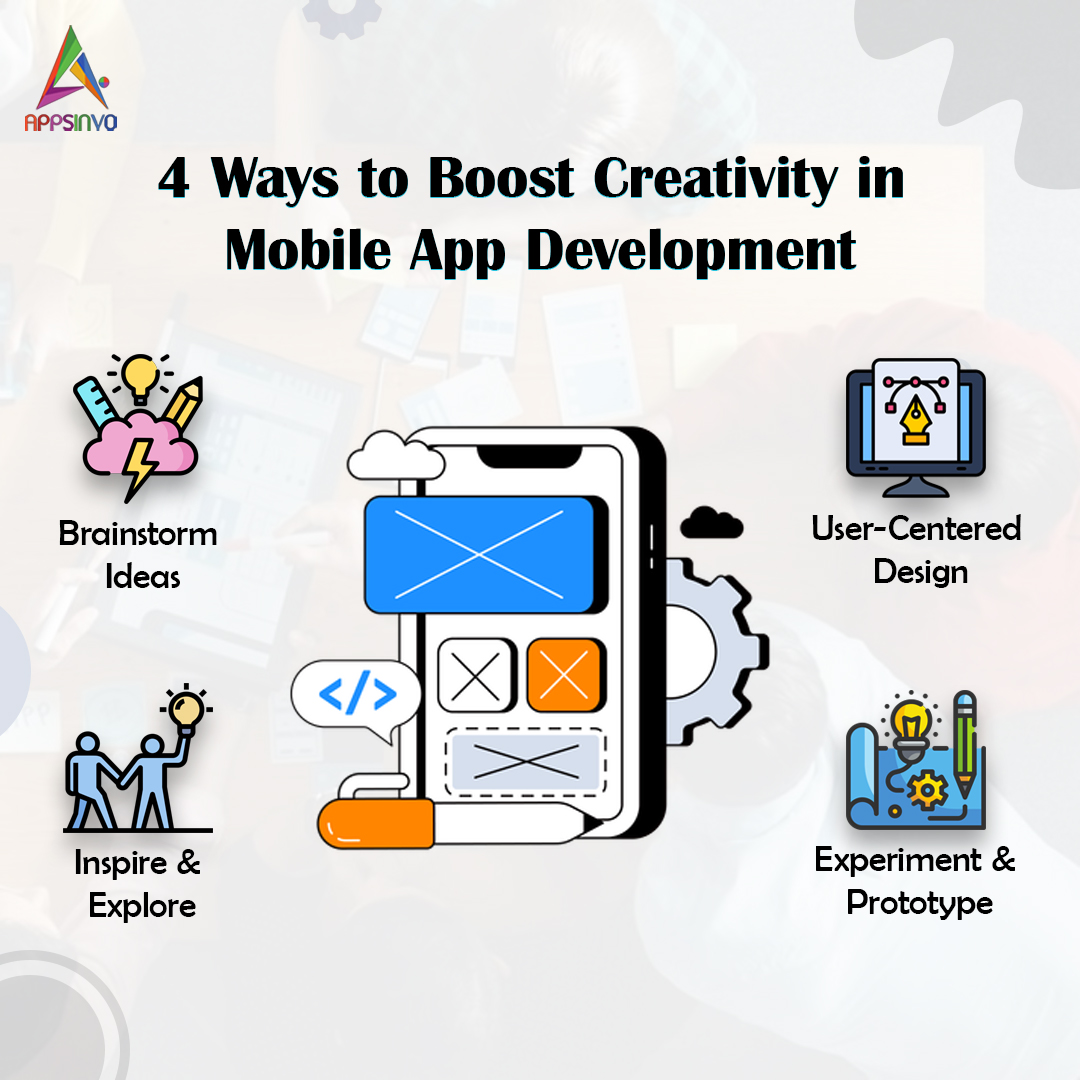
Creativity is emerging as a vital differentiator in mobile app development, rather than merely a “nice-to-have” ability. With thousands of apps released every year, competition is fierce—users may download alternatives in seconds. As a result, original ideas and user-centric solutions are crucial for differentiating oneself in competitive markets.
Innovation enables teams to develop experiences that are new, intuitive, and valuable, which improves both adoption and retention. In this blog, we’ll explore four practical strategies to enhance creativity throughout the app development process. From design thinking and emerging technologies to improved teamwork and continual experimentation, these tactics assist startups, entrepreneurs, and established enterprises in creating mobile apps.
1. Focus on User-Centric Design Thinking
Design thinking is a disciplined approach to innovation that begins with understanding people rather than making assumptions. Rather than asking “What should we build?”, teams ask, “What problem are we solving, and how do users experience it today?” That mentality frequently generates innovative app concepts based on real-world problems.
Develop user personas, which are research-based representations of your target audience. Personas allow you to visualise goals, pain spots, motives, and context. Next, employ feedback loops to stay informed about what consumers are actually saying: surveys, app store reviews, customer service insights, and stakeholder interviews are all important.
Then, validate through usability testing. Observing how people engage with prototypes or existing features identifies roadblocks and inspires fresh creative ideas. For example, users may struggle with navigation, necessitating a redesign to increase usability and overall app performance.
Real-world advantages of user-driven innovation include more engagement, fewer development reworks, and a more defined product roadmap. When creativity is grounded in user requirements, it becomes both inventive and effective.
- AI (artificial intelligence): AI can power personalised suggestions, predictive help, smart search, and smarter onboarding. An e-commerce or content app, for example, might customise suggestions based on user behaviour, making the experience more personalised.
- AR/VR stands for augmented and virtual reality: AR technology can enable interactive product previews, navigation overlays, and immersive learning. Even simple AR features can produce memorable events that consumers share.
- Internet of Things (IoT): IoT allows linked experiences such as remote device monitoring, automation triggers, and real-time data—ideal for fitness, home, logistics, and enterprise solutions.
3. Encourage Collaboration and Brainstorming
- Generate ideas freely initially (quantity above judgment).
- Build upon each other’s notions.
- Capture all suggestions, including the “wild” ones.
- Design sprints (time-boxed idea to prototype cycles)
- Brainwriting (silent idea generation prior to group discussion).
- Idea mapping (connecting features with user demands and outcomes)
Shared whiteboards, project boards, and documentation templates can all help teams stay on track, particularly for remote companies.
4. Continuous Learning and Experimentation
Encourage teams to try something new:
- UI/UX patterns include navigation, accessibility, and micro-interactions.
- Development frameworks and tooling
- Backend services and integrations that can decrease friction
Prototyping is a simple yet effective practice. Prototyping reduces risk and accelerates learning. Clickable demos, feature flags, or beta releases can let you test new ideas early on. This strategy also improves app performance by allowing teams to optimise experience and speed before a full-scale launch.
Importantly, learning from setbacks fosters innovation. When an experiment fails, it delivers data—users did not interact for a reason, and this information may be used to influence the next iteration. This fosters a culture of experimentation, resulting in higher-quality innovative app concepts.
Experimentation also helps startups keep their budgets intact. Rather than spending months developing the incorrect feature, you validate immediately and iterate.
FAQs: Mobile App Creativity & Innovation
1. How do we generate innovative app ideas without wasting time?
Begin with user research, identify a specific problem, and then quickly develop solutions. Then, rather than guessing, develop the top 1-2 concepts to confirm them early on.
2. What’s the best technique to boost UI/UX design creativity?
Use design thinking to gather input and assess usability. Understanding user behaviour and removing friction from the flow enhances creativity.
3. Can upcoming technologies such as AI actually increase app performance?
Yes, when applied appropriately. AI can automate tasks (smart search, recommendations) and streamline operations. You should also thoroughly evaluate and optimise the performance consequences.
4. How frequently should a product team experiment with mobile app development?
There is no set quantity, although numerous small experiments, such as weekly usability testing or monthly feature pilots, can be beneficial for startups and growing teams.
5. What is the function of collaboration in app innovation?
Collaboration keeps “creative ideas” from becoming unrealistic. Early collaboration among designers, developers, and strategists results in ideas that are both innovative and buildable.
6. How do we stay inventive after the launch?
Use analytics, user input, and continuous A/B testing to determine what to enhance next. Creativity does not stop with the release; it continues to evolve in response to user needs and market changes.
Conclusion