
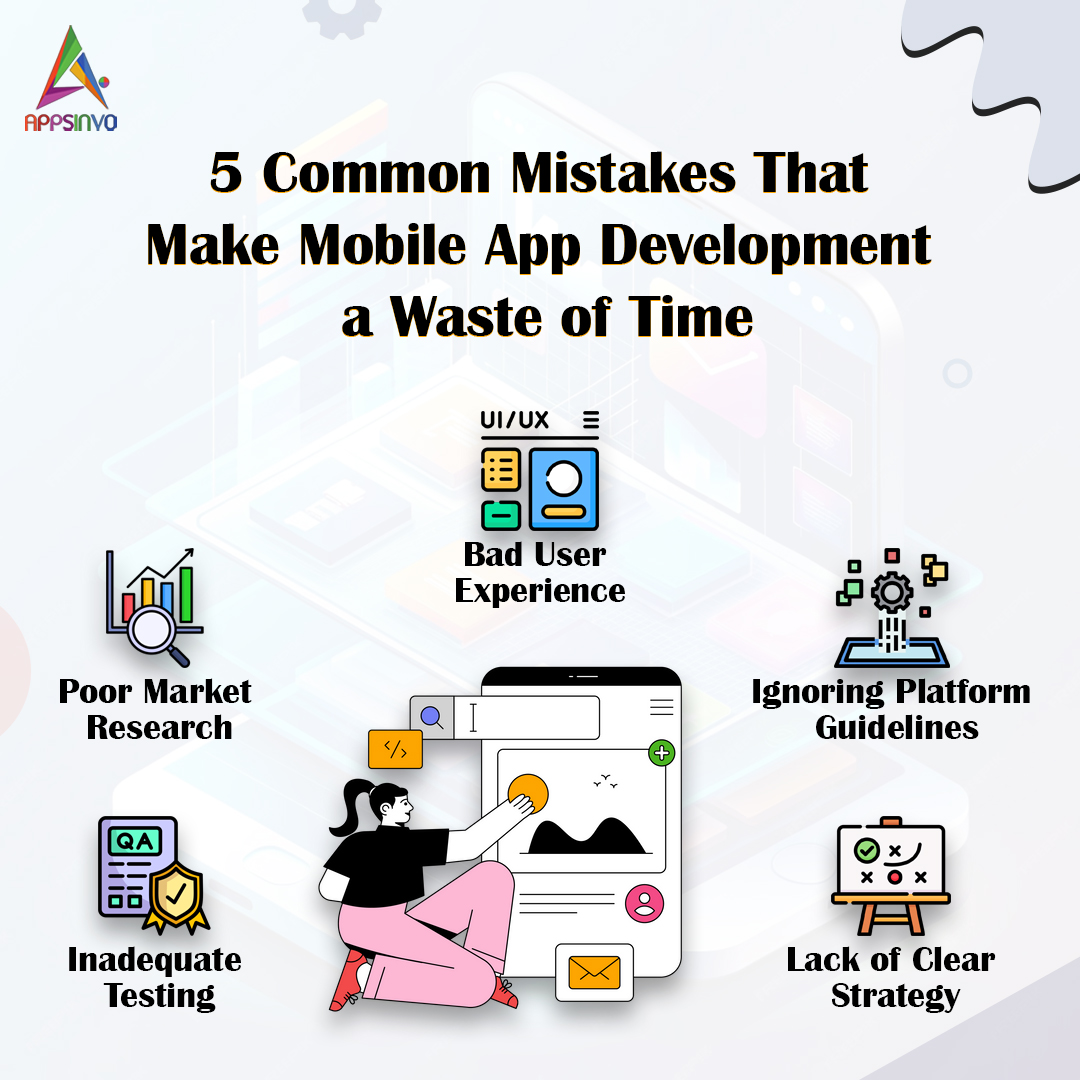
Mistake #1: Lack of clear goals and strategies
Without a plan, teams struggle to prioritise, resulting in an app that is either too wide (“little bit of everything”) or too constrained to be helpful. What was the result? Users don’t perceive value, and business results don’t increase.
- How to Avoid It : (Quick Tip) Conduct market research, choose 1-3 quantifiable objectives (such as conversion rate or retention), and develop a concise plan. Set expectations for success among stakeholders early on.
Mistake #2: Ignoring the User Experience (UX)
Consider it from the customer’s perspective: If a user needs to tap too many times to access the cart, or if the app freezes during checkout, they are likely to leave the journey and go elsewhere. This has an impact on not only engagement but also reviews, retention, and, eventually, income.
- How to Avoid It: Prioritise intuitive design. Use usability testing (even with a small group) to identify potential friction points early. If users can’t figure it out in minutes, you should reconsider your mobile app development strategy.
Mistake #3: Choosing the Wrong Development Approach
Another typical app mistake is adopting a “one-size-fits-all” development strategy without first assessing business requirements. Some teams choose native development because it sounds better, while others choose cross-platform to save time and money—but neither choice is always correct.
Native apps can provide exceptional performance and platform-specific experiences, but they may be more expensive and take longer to develop. Cross-platform development can be faster, but performance and UI polish may require additional attention, especially for sophisticated features.
- How to Avoid It: Consider aspects such as target platforms, timeframe, complexity, performance requirements, team competence, and long-term strategy. The optimal technological option benefits your app strategy, not simply its initial launch.
Mistake #4: Avoiding testing and quality assurance
Many business owners misunderstand what testing should include:
- Functional testing: Does each feature function as intended?
- Performance testing: Does the app remain responsive under real-world conditions?
- Security testing: Is user information and payment protected?
And here’s the terrible reality: Fixing flaws after release is typically much more expensive than catching them during development.
- How to Avoid It: Use continuous testing throughout the development process. Test with real devices and different network circumstances. Security should be a part of the process, not an afterthought.
Mistake #5: No post-launch strategy
After launch, you will need:
- Updates and maintenance include bug fixes, feature improvements, and OS compatibility.
- User feedback loops (reviews, analytics, and customer support insights).
- User acquisition and marketing (to encourage people to download and utilise the app).
For example, if your product solves a real need but the onboarding is inadequate, you will only realise after launch. If you don’t have a plan to improve onboarding, engagement can dwindle—and ROI becomes difficult to prove.
- How to Avoid It: Before you start, create a roadmap for maintenance and enhancement. Monitor user behaviour and iterate based on evidence, not assumptions.
Conclusion