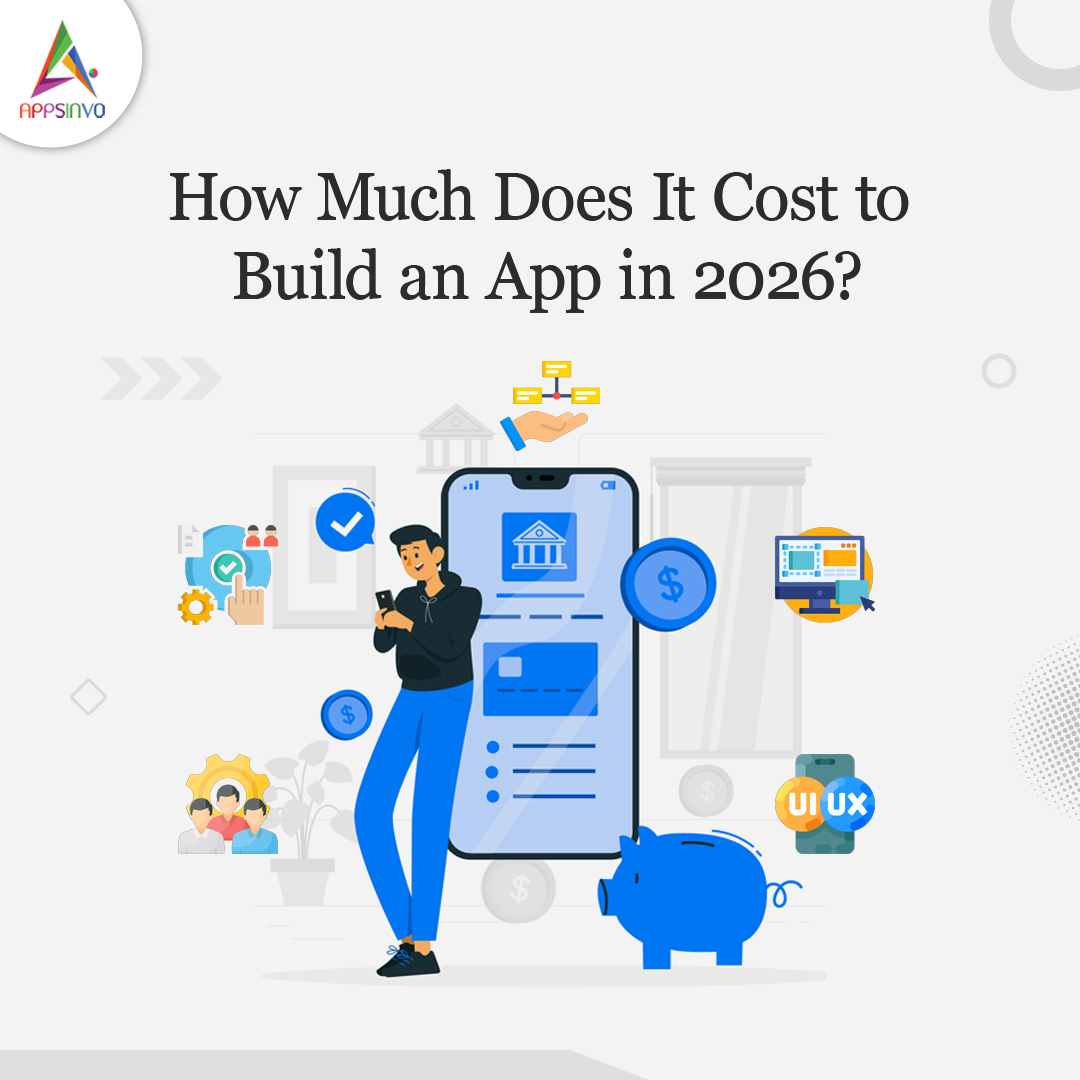
How Much Does It Cost to Build an App in 2026?

0
47
How-Much-Does-It-Cost-to-Build-an-App-in-2026 by Appsinvo Blog
In 2026, many companies will invest in mobile applications as customers seek seamless, personalised digital experiences. AI capabilities, automated processes, cloud-based features, and improved system integrations are in high demand.
That raises one recurrent question: how much does it cost to launch an app in 2026? The answer is determined by scope, technology choices, team structure, and growth strategy—particularly if you want your app to remain safe and scalable long after it is launched.

Factors That Influence App Development Cost

Budgets for app development vary greatly since development is a series of decisions rather than a single line item. Here are the top cost drivers for app development in 2026.

1) App complexity (basic, medium, and advanced)

Complexity serves as the foundation for everything else, including time, technical effort, and quality assurance needs.
  • Most basic apps are read-only or do simple CRUD operations (create/read/update/delete).
  • Medium apps provide user accounts, roles, integrations, and more screens.
  • Complex processes, live features, artificial intelligence, payments, and compliance are all characteristics found in advanced apps.

2) Number of displays.

Each screen usually has UI elements, navigation, validation logic, and testing. More screens improve content management, accessibility, and edge-case QA.

3) UI/UX design specifications

Strong UI/UX improves conversion and retention, particularly for e-commerce, on-demand, and finance. Custom designs (rather than templates) will incur extra design and iteration expenses.

4) Android, iOS, or cross-platform development

The decision between native Android app development and iOS app development has an impact on the development and testing effort. Cross-platform frameworks such as Flutter and React Native can save time by sharing code, but platform-specific work is still required.

5) Backend Infrastructure

Almost all mobile apps require a backend, which includes databases, authentication, APIs, file storage, and administrative tools. If you already have infrastructure, the cost may be lower; otherwise, backend development becomes a big budget component.

6) APIs and third-party integrations

If your app communicates with payment providers, maps, CRMs, messaging services, or analytics, integration work increases. Each integration may necessitate specialised handling, rate-limit tuning, and monitoring.

7) AI and Machine Learning features

Model design, data pipelines, and inference infrastructure typically drive up the cost of developing an AI application. Costs vary depending on whether you use off-the-shelf AI APIs or develop specialised logic for your domain.

8) Real-time chat and notifications

Real-time features necessitate additional infrastructure and testing. Chat, push notifications, and event-driven workflows also help with QA because edge cases occur frequently in live environments.

9) Payment gateway integration

Payments increase the complexity of security, tokenisation, refund processes, and regulatory obligations. You may additionally require receipts, invoicing logic, and dashboard displays for operations.

10) Security and Compliance

Security is not optional. Secure authentication, encryption, audit logs, and role-based access all result in higher costs. For regulated businesses, compliance planning may have a substantial impact on timelines and budget.

11) Cloud Hosting

Hosting costs are determined by predicted traffic, storage requirements, and computation intensity (particularly with AI). Many teams set up time for monitoring, logging, and incident preparation.

12) Scalability

Scalability planning includes performance considerations, caching strategies, database indexing, and load testing. If you expect to develop, preparing ahead of time saves you time and effort later.

13) App testing and QA

Functional tests, regression tests, device testing, usability reviews, and security checks are all part of quality assurance (QA). Users want high-quality applications in 2026, therefore, QA will play an important role in app development services.

14) Application deployment

App store setup, build pipelines, versioning, and release note management are all part of the deployment process. Depending on the sort of app, you may face extra review concerns.

15. Ongoing maintenance and updates.

Launch is not the endpoint. Maintenance includes bug repairs, operating system updates, performance enhancements, new features, and security patches.


Estimated App Development Cost in 2026 (Pricing Ranges)

The following is a feasible estimation range based on app complexity. The final price is determined by your features, technology stack, schedule, development team size, and location
Pricing Comparison Table (Estimated Ranges)
App Type / Complexity Typical Scope Estimated Range (2026)
Simple Business App (Basic) Login, catalog pages, contact/lead capture $20,000 – $40,000
E-commerce App (Medium) Product listing, cart, payments, user accounts $40,000 – $100,000
Food Delivery App (Advanced) Ordering, tracking, dispatch logic, ratings $100,000 – $200,000
Healthcare App (Advanced/Regulated) Scheduling, records, secure auth, compliance needs $120,000 – $310,000+
Taxi Booking App (Advanced) Geolocation, dispatch, real-time status $90,000 – $210,000
FinTech App (Advanced/Regulated) Wallets, payments, KYC flows, audit logs $140,000 – $310,000+
AI-powered Application (Advanced) AI recommendations, chat/assistants, inference pipeline $120,000 – $350,000+
Social Media App (Advanced) Feeds, media uploads, moderation, scaling needs $130,000 – $300,000+
Enterprise Application (Advanced) Roles, integrations, admin dashboards, SSO $120,000 – $400,000+


Example Expectations (Quick Context)
  • Simple Business App: quicker delivery due to reduced workflows.
  • AI-powered application: increased cost owing to AI logic, evaluation, and continuous tweaking.
  • Enterprise/FinTech/Healthcare: increased investment owing to security, compliance, integrations, and administrative tools.

Important: these are ranges, not quotations. Actual prices vary depending on the project’s needs, features, technology stack, development duration, and development partner.

Development Timeline

Timelines reflect complexity, review cycles, and QA depth. Typical timelines for 2026 planning:

Simple apps

Usually 8–12 weeks for a streamlined MVP with essential features, basic admin, and standard integrations.

Medium-complexity apps

Often 3–5 months, including deeper UI/UX refinement, authentication, multiple integrations, and more thorough QA.

Enterprise applications

Commonly 5–8 months due to roles/permissions, internal workflows, SSO/integration needs, and extended testing.

AI-powered mobile apps

Often 4–7 months depending on whether AI uses ready APIs or involves custom models, prompt/workflow design, evaluation, and quality iteration.

Hidden Costs Businesses Often Forget

Many budgets are startled by “secondary” costs that are nonetheless relevant.
  • App Store and Google Play fees: Building an account and continued publication requirements.
  • Server costs: Hosting services include databases, storage, bandwidth, and monitoring.
  • Third-party API subscriptions: mapping, messaging, payment add-ons, and analytics systems.
  • Maintenance: OS compatibility, bug fixes, and performance enhancements.
  • Security updates: Patching dependencies and securing authentication flows.
  • Feature enhancements: Iterative improvements depending on user input.
  • Marketing and ASO: To increase installations, use store listing assets, experimentation, and optimisation.
  • Customer Support: Tooling, ticketing, and response processes.
  • Analytics technologies: include event monitoring, dashboards, and attribution logic.

Tips to Reduce App Development Cost

Reducing cost doesn’t mean cutting quality—it means avoiding waste and building the right scope first.
1. Build an MVP first.
Validate demand early on using the simplest set of features that provide meaningful user value.
2. Prioritise the vital aspects.
Before you begin development, decide what is “must-have” and what is “nice-to-have”.
3. Select cross-platform development when appropriate.
 Flutter or React Native may help many startups save time while still providing a great user experience.
4. Use agile development.
Short iterations decrease rework and allow you to alter the scope depending on actual progress and feedback.
5. Plan scalable architecture

This prevents expensive rewrites later when you grow users, data, or traffic.

6. Work with an experienced development company

A senior team avoids common pitfalls that inflate budgets (poor requirements, weak QA, fragile integrations).

7. Avoid unnecessary feature overload
Every extra feature increases QA scenarios, backend logic, and release complexity.

8. Define clear project requirements up front
Clear acceptance criteria and user stories reduce ambiguity-driven costs.


Why Choose Appsinvo?

If you’re looking for mobile app development costs in 2026, you’ll need predictability and a partner who can translate needs into a dependable delivery schedule.
Appsinvo provides end-to-end support for businesses building modern apps, including:
  • Custom Android & iOS app development
  • AI-powered application development
  • Flutter and React Native development
  • UI/UX design services
  • Enterprise app development
  • Startup MVP development
  • Solutions across Healthcare, FinTech, E-commerce, Education, Logistics, Real Estate, Travel, and On-Demand models
  • Transparent pricing and scope alignment
  • Agile development methodology to manage change efficiently
  • Experienced developers focused on quality engineering
  • On-time delivery
  • Post-launch support and maintenance
Appsinvo’s strategy focuses on innovation, scalability, security, and user pleasure, ensuring that your app performs and evolves rather than just launching.

Suggested internal linking opportunities (for your blog CMS)

  • App Development Services
  • AI App Development
  • Android App Development
  • iOS App Development
  • Flutter App Development
  • Contact Us
  • Portfolio
  • Blog

FAQ

1) How much will it cost to develop an app in 2026?

Costs generally range from $25,000 to $450,000 or more, depending on complexity, platform (Android/iOS/cross-platform), integrations, backend requirements, AI capabilities, and continuous maintenance.

2) What is the average cost of app development in 2026 for an MVP?

An MVP for a simple to medium app typically costs between $25,000 and $120,000, with the schedule and price increasing depending on authentication, payments, and third-party connections.

3) Will AI boost aplopmentp deve costs in 2026?

Yes, the cost of developing an AI app rises owing to AI workflow design, assessment, and possibly bespoke model work or inference infrastructure—even when utilising AI APIs.

4) Does it cost less to create for Android or iOS?

Native prices might vary, and team setup counts. Cross-platform development (Flutter/React Native) sometimes saves total build effort, but you should still set aside time for platform-specific optimisation and testing.

5) What continuing expenditures should we budget for after the app launches?

Expect to pay for maintenance and upgrades, security patches, bug fixes, monitoring, server/hosting, analytics, and, in certain cases, marketing/ASO and customer support.

Conclusion

So, how much will it cost to design an app in 2026? The most reliable estimation method is to include complexity (features, screens, processes), platform strategy (Android/iOS/cross-platform), backend and integrations, AI needs, security and compliance, and the continuous effort required for maintenance and growth.

If you want a cost estimate based on your business goals rather than guesswork, deal with a development company that can plan scope, timetables, and risks ahead of time.

Are you ready to design your mobile app in 2026? Contact Appsinvo now to schedule a free consultation and obtain a pricing estimate suited to your specific company needs.


Given Below are Some Mobile App Development Related Blogs:-

🔗 Common Mistakes to Avoid in Mobile App Development
🔗 The Complete Guide to Google Play App Store Optimization for Android Apps in 2025
🔗 Building a Mobile App from Scratch
🔗 Mobile App Development Company Growth Strategies in India
🔗 Latest Top 10 UX/UI Tools Used For App Design
🔗 Roles of Mobile App Consulting Services for Your Business App
🔗 Top Techniques to Build and Develop the Best Mobile App for Business
🔗 What Are the Basics of Mobile App Development?
🔗 How to Choose the Right Mobile App Development Company
🔗 Top 15+ Tools for Building a Mobile App
🔗 How Does User Experience Impact Mobile App Development?
🔗 What are the best Practices for Mobile App Development?
🔗 6 Benefits of Outsourcing to a Mobile App Development Company
🔗 The Impact of Technology on Mobile App Development Companies in India
🔗 What are the Key Considerations for Mobile App Creation?
🔗 Mobile App Development Company Growth Strategies in India
🔗 What are the best Practices for Mobile App Development?
🔗 How Does User Experience Impact Mobile App Development?
🔗 What Are the Basics of Mobile App Development?
🔗 How to Choose the Right Mobile App Development Company in 2024
🔗 10 Essential Steps for Mobile App Development
🔗 How Can Mobile App Development Benefit Your Business?
🔗10 Reasons to Invest in a Top Mobile App Development Company in India
🔗 Top Trends in Mobile App Development for 2024
🔗List of Top 10 Mobile App Development Frameworks in 2024
🔗Exploring the Future of Augmented Reality in Mobile App Development
🔗 Challenges of Enterprise Mobile App Development
🔗 Top Mobile App Development Using Angular Frameworks
🔗 Why IoT is the Future Of Mobile App Development?
🔗 Significance of DevOps in Mobile App Development
🔗 Worst Mobile App Development Mistakes Need to Avoid
🔗 Factors That Affect the Success of Web & Mobile App Development
🔗 Cloud-Native App: The Future of Mobile App Development
🔗 Stages of Cross-Platform Mobile App Development
🔗 Important Points Should Follow for Mobile App Development
🔗 Benefits of Integrating IoT into Mobile App Development Process
🔗 Progressive Web Apps- A New Trend of Mobile App Development
🔗 Points You Must Consider While Mobile App Development
🔗 What is the Future of Mobile App Development


LEAVE A REPLY

Please enter your comment!
Please enter your name here