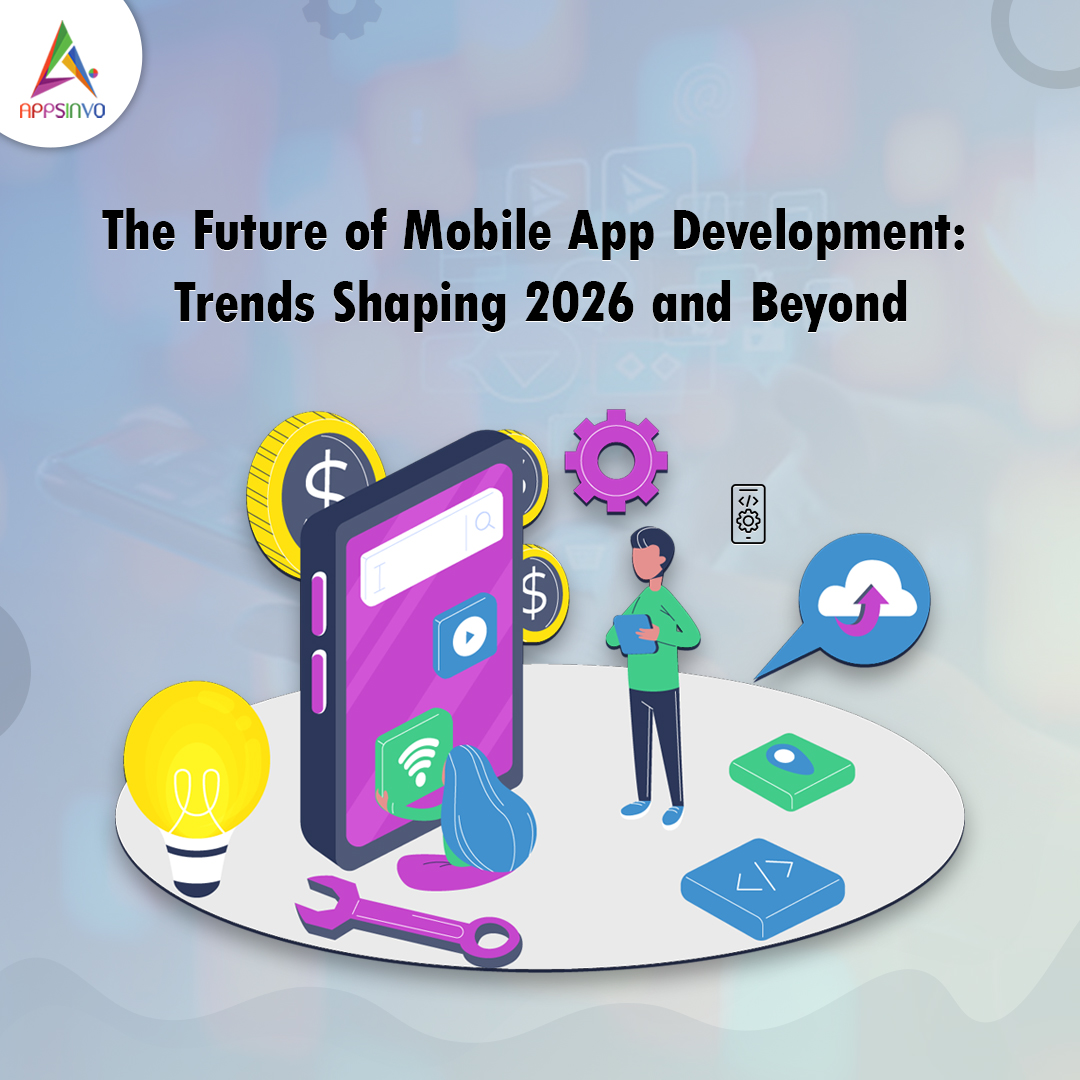
Mobile app development is entering a new age, characterised by better experiences, faster delivery, more security, and deeper interaction with emerging technologies. As we look ahead to 2026 and beyond, developers and product teams must adjust to changes in user expectations, platform capabilities, and engineering best practices. The following are the most important themes affecting the future of mobile app development, along with their implications for businesses.
1) AI-Powered Apps Are the New Standard
AI is transitioning from “nice-to-have” additions to fundamental app functionality. In 2026, more applications will use AI for personalisation, predictive insights, intelligent search, and automated customer service. AI-driven suggestions may boost user engagement, while generative AI can help speed activities like summarising material, writing messages, and supporting users with troubleshooting. Businesses must also handle responsible AI, which includes ensuring accuracy, transparency, and privacy compliance.
Expect an increase in:
- Customised experiences depending on user behaviour
- AI copilots inside apps to boost productivity
- Improved chatbots and customer support automation
- AI-assisted QA/testing reduces problems and time-to-release
2) Cross-Platform Development Gets Deeper
Cross-platform frameworks will continue to grow, providing increased performance, enhanced UI consistency, and easier access to device functionalities. Teams will increasingly embrace cross-platform ways to cut development costs and shorten time to market while maintaining native-like performance. By 2026, the emphasis will change from “can we build it?” to “can we build it efficiently at scale?” This will result in enhanced tooling, common component libraries, and improved development workflows.
3) Modular Architecture and Microservices for Mobile Backends
App architecture will be developed to enable faster iteration and scaling. Developers are using modular architectures that separate issues such as login, alerts, payments, and content delivery. When combined with microservices or API-first designs, this allows teams to update functionality without disrupting the entire system.
Benefits include:
Faster feature release cycles.
Easy maintenance and testing
Increased flexibility as product requirements evolve.
Easy maintenance and testing
Increased flexibility as product requirements evolve.
4) Edge Computing: Faster and More Reliable Experiences
Latency matters. Users demand quick replies, especially for apps that need real-time interactions, such as gaming, navigation, and IoT management. Edge computing minimises latency by processing data near the consumer. This trend will improve the performance of apps in computer vision, voice processing, and real-time analytics. While the cloud will remain critical, edge computing will become increasingly vital for applications that require quick reaction.
5) Privacy, Security, and Compliance by Design.
Security is no longer a secondary consideration; it is a product requirement. With stronger restrictions and increased cyber risks, mobile apps must incorporate security at every level of development. In 2026 and beyond, anticipate more attention on:
- Secure authentication (with MFA)
- Encryption of data in transit and at rest
- Zero-trust methods
- Secure APIs and hardened backend services
- Compliance-ready logging and audit trails
Users are also more conscious of how their data is managed. Transparent privacy controls, permission management, and minimum data acquisition will be crucial differentiators.
6) Improved App Store Strategies and Continuous Updates.
App Store Optimisation (ASO) will continue to progress. Beyond marketing information, developers will prioritise continuous delivery, delivering enhancements more often and safely through feature flags, phased rollouts, and automated monitoring. This allows teams to react more swiftly to customer input, resolve performance issues faster, and decrease downtime during upgrades.
7) The Growth of Super Apps and Ecosystem Thinking
Instead of single-purpose applications, organisations will increasingly create multi-functional “ecosystems.” Super apps include payments, messages, bookings, support, and commerce. Even if a company does not create a complete super app, it will require deeper interfaces with partners, services, and third-party APIs to give comprehensive value.
8) AR/VR and Spatial Computing in Widespread Use
AR and VR are increasingly becoming more accessible. With advancements in device performance and consumer uptake, spatial experiences will expand beyond specialised applications. AR elements such as product visualisation, interactive advice, and immersive learning will help the retail, education, healthcare, real estate, and training industries.
9) Improved Developer Experience with Automation and AI-Assisted Delivery.
The future of app development will focus not only on end-user features, but also on enhancing developer operations. AI-driven automation will speed up processes like code review suggestions, test generation, log analysis, and issue identification. When used with CI/CD pipelines, this lowers manual work while improving overall quality.
Key areas for developer productivity include:
- Automated testing and regression suites
- Monitoring and alerting with smart anomaly detection
- Faster debugging using structured logs and traces
10) Apps that promote sustainability and resource efficiency
Sustainability is becoming a strategic focus. Resource-efficient apps save battery life, reduce bandwidth use, and improve server workloads. Companies will increasingly evaluate app performance in terms of energy consumption and compute efficiency, particularly as worldwide adoption rises and infrastructure expenses become a greater issue.
Final Thoughts
AI, security-first engineering, smarter design, and immersive experiences will all come together to alter the mobile app development scene in 2026 and beyond. Businesses that invest in scalable foundations, current development processes, and user-centred design will grow quicker and remain competitive. The successful strategy is more than just using new technologies; it is also about developing apps that are intelligent, safe, dependable, and adaptable to shifting user expectations.