Healthcare mobile applications are transforming how people access and deliver care. Patients can book digital consultations, manage appointments, view health records, and receive reminders, while clinicians can monitor patients remotely and coordinate care more efficiently. These capabilities can improve access to medical services—but only when apps are reliable, secure, and designed around real-world needs.
For startups, clinics, hospitals, and healthcare businesses, working with an experienced Healthcare App Development Company in India can help turn an idea into a practical digital health solution. Understanding the challenges early is essential to building an application that patients and care teams can trust.
Understanding Healthcare App Development
Healthcare App Development involves more than creating a polished mobile interface. An app may handle sensitive patient information, connect to clinical systems, and support decisions that affect people’s health. It must be easy to use while also being secure, scalable, and dependable.
The right Healthcare Mobile App Development approach begins with the needs of both patients and providers. For example, a telemedicine app should make it simple to book and join a consultation, while giving clinicians a clear way to review relevant patient information.
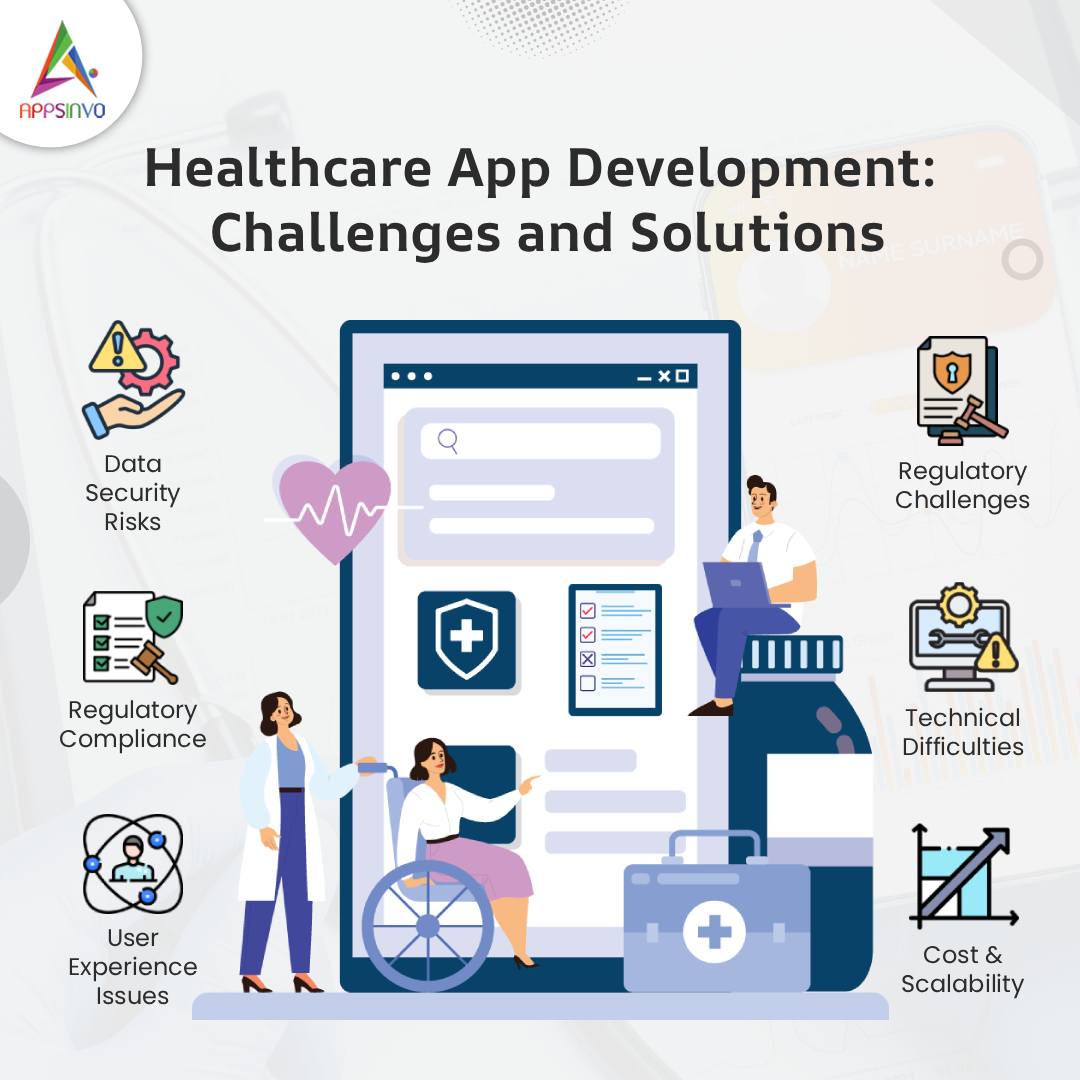
Major Healthcare App Development Challenges and Solutions
1. Data Security and Patient Privacy
Health information is highly sensitive, making unauthorized access or data exposure a serious risk. Build security into the product from the start: use encryption, role-based access, secure authentication, audit logs, and regular security testing. Collect only the data the app needs and define clear retention and access policies.
2. Regulatory Compliance and Healthcare Standards
Requirements vary based on the app’s purpose, users, and markets. A solution handling protected health information in the United States, for instance, may face different obligations than one serving users in India. Identify applicable privacy laws and sector requirements early, document data flows, and consult qualified compliance professionals. Standards such as HL7 and FHIR can also guide health data exchange.
3. Integration with EHR/EMR Systems
Connecting an app to existing Electronic Health Record or Electronic Medical Record systems can be difficult because platforms may use different formats and interfaces. Begin by assessing the target systems and their available APIs. Use standards-based interfaces where possible, validate data mapping, and test integrations with healthcare teams before launch. Effective EHR/EMR Integration can reduce duplicate data entry and help providers access relevant records.
4. Data Accuracy and Real-Time Monitoring
Outdated or incorrect readings can undermine patient and provider confidence. Validate data at the point of entry, show when information was last updated, and create checks for missing or unusual readings. For remote monitoring, define thresholds and escalation workflows with clinical stakeholders; the app should not imply that every alert replaces professional judgment.
5. User Experience and Accessibility
Patients may include people of different ages, abilities, and levels of digital confidence. Use plain language, readable text, clear navigation, and accessible colour contrast. Test key tasks—such as booking an appointment or accessing a prescription—with representative users. A simpler experience can reduce mistakes and improve adoption.
6. Interoperability with Medical Devices
Wearables and connected devices may vary in connectivity, data formats, and measurement quality. Select devices based on the use case, test across supported models, and communicate pairing or sync issues clearly. Where possible, standardize incoming data and provide a fallback for manual entry.
7. Scalability and App Performance
Growth in users, records, or concurrent consultations can affect speed and reliability. Plan the architecture for expected demand, monitor performance, and test under realistic usage conditions. Cloud infrastructure can support flexible capacity, but it still needs careful configuration, backup, and access controls.
8. Third-Party API and System Integration
Payment services, video consultations, maps, and messaging tools can add useful functionality, but they also introduce dependencies. Review each provider’s security, uptime, data handling, and support terms. Use secure API management, monitor failures, and design graceful alternatives when an external service is unavailable.
How Advanced Technologies Help
AI and Machine Learning can assist with tasks such as organizing information or identifying patterns, subject to appropriate validation and human oversight. IoT and wearable technology enable continuous or periodic health-data collection. Cloud Computing can support secure storage and scalable services when configured responsibly. Together, these technologies can strengthen Healthcare Software Solutions, but they should be chosen to meet a clear clinical or operational need—not added simply because they are fashionable.
How to Build a Successful Healthcare Application
A structured process helps manage risk and avoid costly rework:
- Research: Identify users, care workflows, market needs, and applicable requirements.
- Plan: Define features, integrations, data flows, and measurable outcomes.
- Design: Create and test accessible UI/UX prototypes with patients and providers.
- Develop: Build in manageable stages, prioritizing essential functionality.
- Test: Check usability, performance, security, and integrations across devices.
- Maintain: Monitor the app, address issues, update dependencies, and improve it using feedback.
Why Choose Appsinvo for Healthcare App Development?
Appsinvo provides customized mobile app development solutions for startups, clinics, hospitals, and enterprises. Its services include mobile app development, UI/UX design, software quality assurance, AI, and IoT development. As a Healthcare App Development Company in India, Appsinvo can work with your team to shape a solution around your users, workflows, and business goals—from planning and design through development and ongoing support.
For teams seeking Custom Healthcare App Development, the right partner should communicate clearly, understand integration and security needs, and build around the project’s actual requirements. Appsinvo highlights a transparent process, NDA options, quality assurance, and post-launch maintenance—useful considerations when evaluating a development partner.
Conclusion
Healthcare apps must balance privacy, compliance, integration, usability, and performance. Addressing these challenges early—with careful planning, testing, and ongoing maintenance—can make digital care more dependable for patients and providers. Choosing an experienced Healthcare App Development Company in India can help you navigate the process and build for long-term growth. Contact Appsinvo to discuss your healthcare app development requirements and explore a solution tailored to your goals.
Frequently Asked Questions
What is the biggest challenge in healthcare app development?
Protecting sensitive patient data while keeping the app usable and connected to clinical workflows is a common challenge. Security and privacy should be considered from the planning stage.
How can healthcare apps connect with EHR or EMR systems?
Teams can assess the target systems’ APIs, map data carefully, and use healthcare interoperability standards where supported. Testing with the relevant providers is essential.
What should a healthcare app include to support accessibility?
Clear navigation, readable text, accessible colour contrast, plain language, and testing with diverse users can make an app easier to use.
Can healthcare apps use wearable-device data?
Yes. Apps can collect data from compatible wearables, but teams should test device reliability, explain sync status, and handle missing or inconsistent readings appropriately.
Why is ongoing healthcare app maintenance important?
Maintenance helps address bugs, security updates, changing platform requirements, performance issues, and user feedback after launch.
Explore More Mobile App Development Insights
Guides, comparisons and expert tips from the Appsinvo team, grouped by topic.
Cost & Choosing a Development Partner
Budget, pricing and how to pick the right team.
- How Much Does It Cost to Build an App in 2026?
- What Is the Cost of Designing a Mobile App?
- How to Choose the Right Mobile App Development Company
- 6 Benefits of Outsourcing to a Mobile App Development Company
- 10 Reasons to Invest in a Top Mobile App Development Company in India
- Top Features Every Leading Mobile App Development Company Offers
- Roles of Mobile App Consulting Services for Your Business App
- Mobile App Development Company Growth Strategies in India
- The Impact of Technology on Mobile App Development Companies in India
Getting Started & Strategy
Step-by-step guides from idea to App Store.
- What Are the Basics of Mobile App Development?
- Mobile App Development Strategies for Beginners
- How to Learn Mobile App Development (Beginner’s Guide)
- Building a Mobile App from Scratch
- 10 Essential Steps for Mobile App Development
- 5 Simple Steps to Create an Effective Mobile App Development Strategy
- Step-by-Step Guide to Developing a Successful Mobile App in 2026
- How to Succeed in Mobile App Development (Step-by-Step Guide)
- From Idea to App Store: A Complete Mobile App Development Journey
- Mobile App Development Lifecycle: From Planning to Deployment
- Mobile App vs Website: Which Should You Build First?
- The Ultimate Guide to Creating Innovative Mobile Applications
Platforms, Technology & Tools
Compare frameworks and pick the right stack.
- Android vs iOS: Which Platform Is Better for App Development?
- Android vs iOS App Development: Which Is Better for Your Business?
- Native vs Hybrid Apps: Which One Is Right for Your Business?
- Flutter vs. React Native: A Detailed Comparison for 2026
- Difference Between Kotlin and Flutter: A Complete Comparison
- Why Cross-Platform App Development Is a Smart Choice in 2026
- Stages of Cross-Platform Mobile App Development
- Choosing the Right Technology Stack for Your Mobile App
- Top 10 Mobile App Development Frameworks
- Top Mobile App Development Using Angular Frameworks
- Top 15+ Tools for Building a Mobile App
AI, Trends & Emerging Tech
What’s next for mobile apps in 2026 and beyond.
- The Future of Mobile App Development: Trends to Watch in 2026
- The Future of Mobile App Development Trends Shaping 2026 and Beyond
- Top Trends in Mobile App Development
- How AI Is Transforming the Future of Mobile App Development
- AI Integration in Mobile Apps: Opportunities and Challenges
- Integrating AI in Mobile Apps: Use Cases, SDKs, and Privacy Considerations
- The Future of Mobile Apps: AI and Machine Learning Integration
- Why IoT Is the Future of Mobile App Development?
- Benefits of Integrating IoT into the Mobile App Development Process
- Exploring the Future of Augmented Reality in Mobile App Development
- Cloud-Native App: The Future of Mobile App Development
- Progressive Web Apps: A New Trend of Mobile App Development
- On-Demand App Development: Why It’s Growing Rapidly in 2026
- Significance of DevOps in Mobile App Development
Performance, Compression & Testing
Make apps faster, lighter and more reliable.
- How to Optimize Your Mobile App for Performance and User Experience
- Boost App Speed with Smart Compression Methods in Mobile Development
- Mobile App Optimization: The Power of Data Compression Explained
- Image and Video Compression in Mobile Apps: A Complete Guide
- How to Reduce App Size Using Advanced Compression Techniques
- Best Compression Strategies for High-Performance Mobile Applications
- The Importance of App Testing: Ensuring Quality in Mobile Development
UI/UX, Features & App Store Success
Design choices that keep users coming back.
- Why User Experience (UX) Can Make or Break Your Mobile App
- How Does User Experience Impact Mobile App Development?
- Latest Top 10 UX/UI Tools Used for App Design
- Key Features Every Successful Business App Must Have
- E-commerce App Development: Must-Have Features and Tips
- What Are the Best Practices for Mobile App Development?
- What Are the Key Considerations for Mobile App Creation?
- The Complete Guide to Google Play App Store Optimization for Android Apps
Business Growth & Marketing
Turn your app into a growth engine.
- Why Mobile App Development Is Essential for Business Growth in the Digital Age
- How Can Mobile App Development Benefit Your Business?
- How Custom Mobile App Development Can Boost Your Business Growth
- The Benefits of Custom Software Development for Small Businesses
- How to Win Clients and Boost Sales with Mobile App Development
- 3 Ways Social Media Can Impact Your Mobile App Business
- How to Make Your Mobile App Stand Out in Just 5 Days
- Factors That Affect the Success of Web & Mobile App Development
- Challenges of Enterprise Mobile App Development
- 3 Easy Ways to Speed Up Healthcare App Development
Tips & Common Mistakes
Quick wins and pitfalls to avoid.
- 15 Proven Tips for Mobile App Development Success
- 5 Things You Should Do Immediately for Mobile App Success
- 5 Easy Ways to Turn Your Mobile App Idea into Success
- 3 Effective Ways to Accelerate Mobile App Development
- 4 Ways to Boost Creativity in Mobile App Development
- Top Techniques to Build and Develop the Best Mobile App for Business
- Important Points to Follow for Mobile App Development
- Points You Must Consider While Mobile App Development
- 5 Common Mistakes That Make Mobile App Development a Waste of Time
- Common Mistakes to Avoid in Mobile App Development
- Worst Mobile App Development Mistakes to Avoid
- What Is the Future of Mobile App Development?
Planning an app that users love? Talk to our UI/UX and development experts for a free consultation.